
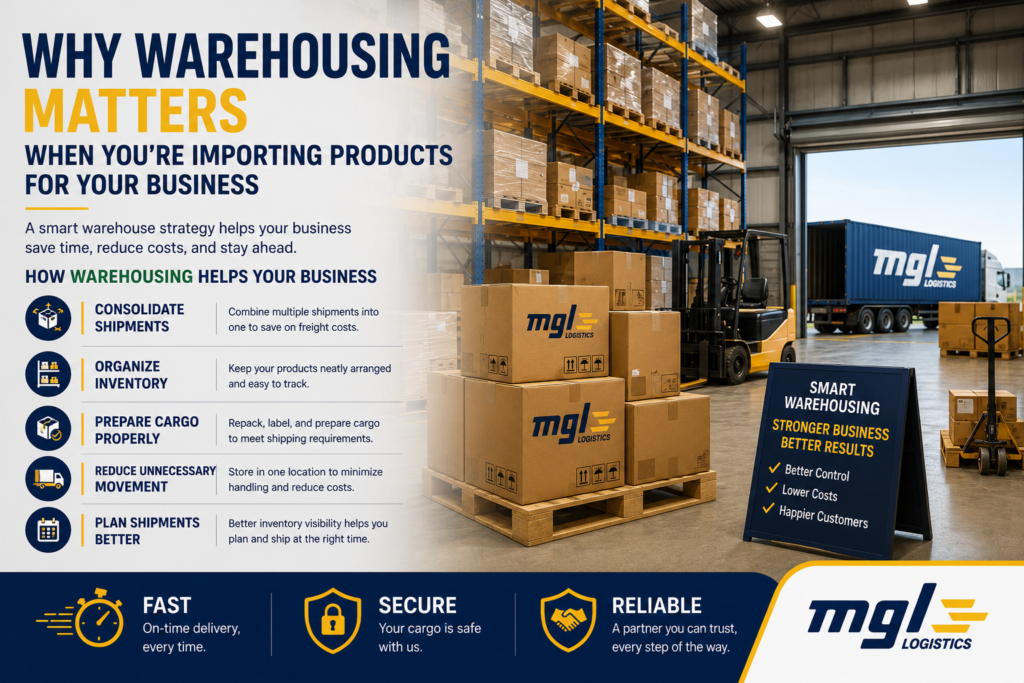
How the right warehousing strategy can help businesses consolidate shipments, organize inventory, prepare cargo, reduce unnecessary movement, and plan more efficiently.
For many business owners, importing products starts with finding the right supplier and securing a good price. But once those products are purchased, another important question comes up:
Where will your goods go before they are ready for their final destination?
When you’re importing products from the USA, Canada, or the UK, having access to reliable warehousing can make a significant difference to how efficiently you manage your cargo.
A warehouse is not simply a place where boxes are kept until they’re shipped. When properly managed, it becomes an important part of your logistics strategy. It can help you bring shipments together, organize inventory, prepare cargo for transportation, and plan your shipments more effectively.
At MGL Logistics, we help businesses make better use of warehousing as part of their wider shipping process, making it easier to manage cargo from suppliers through to its final destination.
What Does Warehousing Mean in International Shipping?
In international logistics, warehousing provides a secure location where goods can be received, stored, organized, and prepared before they continue their journey.
This can be particularly useful when a business purchases products from several suppliers.
For example, imagine you run a retail business in Ghana and purchase products from three different suppliers in the USA. One supplier sends clothing, another sends electronics, and the third sends accessories.
The suppliers may not complete their orders at the same time.
Instead of immediately shipping every order separately, the goods can be received and managed through a warehouse before being consolidated into a larger shipment.
This gives you greater control over your cargo and can make the entire shipping process more organized.
Consolidating Shipments Can Make a Big Difference
Businesses often purchase products from multiple suppliers, and having those goods arrive at different times can make international shipping complicated.
Without proper coordination, you could end up paying for several separate shipments when combining the cargo may be more efficient.
Warehousing provides an opportunity to receive goods from different suppliers and hold them until the appropriate time to ship.
Once the required cargo has arrived, the shipments can potentially be consolidated into a single larger consignment.
This can help businesses make better use of available cargo space, reduce repeated transportation, and simplify shipment management.
For businesses that regularly purchase from multiple suppliers, this can become a valuable part of their overall logistics strategy.
At MGL Logistics, we help businesses coordinate their cargo so that shipments can be managed more efficiently from supplier to destination.
Better Warehousing Means Better Inventory Organization
When you’re dealing with multiple suppliers, keeping track of your inventory can quickly become challenging.
One supplier may send 20 cartons today, another may send 15 cartons next week, while another shipment may arrive later with completely different products.
Without proper organization, it becomes difficult to know exactly what has arrived, what is still in transit, and what is ready to be shipped.
A well-managed warehouse gives businesses a central location where goods can be received and organized.
Inventory can be arranged according to supplier, product type, shipment, quantity, or destination.
This creates better visibility and makes it easier for business owners to understand what they have available before making their next shipping decision.
For growing businesses, that visibility can be extremely valuable.
Preparing Your Cargo Properly Before Shipping
Getting your products from a supplier is not necessarily the final stage of preparation.
Depending on the nature of the goods, cargo may need to be checked, grouped, repacked, labeled, or prepared for the selected freight method.
This becomes even more important when products are arriving from different suppliers in different types of packaging.
A warehouse provides a central location where goods can be prepared before international transportation.
Products may need to be grouped together, packaging checked, or cargo arranged to make better use of available shipping space.
Proper preparation can help reduce unnecessary handling and make the international shipping process more efficient.
At MGL Logistics, we understand that successful shipping starts long before cargo reaches the port or airport. Good preparation at the beginning can make the rest of the journey much smoother.
Reducing Unnecessary Cargo Movement
Every time your cargo moves from one location to another, there is a cost involved.
There is also the possibility of additional handling, delays, or damage.
Without a coordinated warehousing strategy, goods may be moved several times before they even begin their international journey.
For example, cargo could move from a supplier to a temporary storage facility, then to another location, and eventually to a shipping terminal.
That’s a lot of movement before the cargo has even left the country.
Strategic warehousing can help reduce unnecessary transportation by providing a central location where goods can be received, organized, consolidated, and prepared for shipment.
Fewer unnecessary movements can contribute to better cost control, less handling, and more efficient logistics operations.
The goal of warehousing isn’t simply to store products. It’s to create a more organized journey for those products.
Warehousing Helps You Plan Your Shipments Better
Good logistics requires planning.
If you don’t know what inventory you have, where it is, or when your suppliers’ products will arrive, it becomes difficult to make informed decisions about transportation.
Warehousing gives businesses greater visibility over their cargo.
Once products arrive at the warehouse, you have a clearer picture of what is available and what is still expected from suppliers.
This makes it easier to determine when to ship, how much cargo to ship, which freight option to use, and how much shipping space may be required.
For businesses that import regularly, this can be a major advantage.
Instead of reacting to every supplier shipment individually, you can plan your logistics around the bigger picture.
Why Warehousing Becomes More Important as Your Business Grows
A business may start by importing a few cartons at a time.
As sales increase, however, the number of suppliers, products, and shipments can increase as well.
The process that worked when you were importing five cartons may not work when you’re handling fifty or five hundred.
This is where a structured warehousing solution can become particularly valuable.
It can provide the organization needed to manage increasing cargo volumes without making your shipping operations unnecessarily complicated.
Warehousing can be especially useful for:
- E-commerce businesses
- Retailers
- Wholesalers
- Fashion businesses
- Electronics dealers
- Auto parts businesses
- Beauty and cosmetics businesses
- General merchandise importers
Whether you’re importing products for the first time or managing regular commercial shipments, having the right storage and cargo management system can help your business operate more efficiently.
How MGL Logistics Can Help
At MGL Logistics, we see warehousing as part of the bigger logistics picture.
Our objective is not simply to provide a place where your products can stay. We help businesses use warehousing as a practical tool for managing their cargo more efficiently.
Depending on your shipping requirements, warehousing can support:
- Receiving goods from suppliers
- Consolidating multiple shipments
- Organizing inventory
- Preparing cargo for international shipping
- Reducing unnecessary cargo movement
- Coordinating shipments
- Supporting better freight planning
This can be particularly helpful for businesses sourcing products from multiple suppliers across the USA, Canada, or the UK.
A Simple Example
Consider a business owner in Ghana who imports products from five suppliers in the USA.
Without proper coordination, each supplier could send their products separately. The business owner may then have to manage several transportation arrangements, multiple shipping timelines, and different cargo deliveries.
With a coordinated warehousing strategy, the products can be received as they become available, organized in one location, and prepared for consolidation.
Once the required cargo is ready, the business can arrange transportation based on its preferred schedule and shipping needs.
Instead of constantly reacting to individual supplier deliveries, the business owner gains greater control over the overall shipment.
Choosing the Right Warehousing Partner
Not every warehouse provides the same level of service.
When choosing a warehousing and logistics partner, businesses should consider factors such as the warehouse location, cargo handling procedures, inventory organization, security, communication, and how well the facility integrates with international shipping operations.
A warehouse that understands international logistics can provide much more value than simple storage.
It becomes part of your supply chain.
At MGL Logistics, our focus is on helping businesses connect warehousing with the rest of their shipping process so that cargo can move efficiently from supplier to destination.
Warehousing Is More Than Storage
For importers, warehousing shouldn’t simply be viewed as an additional expense.
When managed properly, it can help businesses gain greater control over their supply chain.
It can make it easier to consolidate shipments, organize inventory, prepare cargo properly, reduce unnecessary movement, and plan international transportation more effectively.
Most importantly, it gives business owners more control over when and how their products move.
At MGL Logistics, we help businesses look beyond individual shipments and consider the entire journey of their cargo.
From receiving products from suppliers to preparing and coordinating shipments, our goal is to make international logistics simpler, more organized, and more dependable.
Conclusion
Importing products successfully isn’t just about finding the right supplier. It’s also about having the right system for managing your cargo after the supplier has completed the order.
A reliable warehousing strategy can help businesses consolidate shipments, keep inventory organized, prepare cargo properly, reduce unnecessary movement, and plan shipments with greater confidence.
As your business grows, having the right logistics infrastructure becomes increasingly important.
With MGL Logistics, businesses can have a logistics partner that understands how warehousing fits into the larger shipping process.
Whether you’re importing a few cartons or managing regular commercial shipments, better warehousing can help you move your products more efficiently from supplier to customer.
MGL Logistics — Fast. Secure. Reliable.