
For many businesses, bulk shipping sounds like the smartest financial move.
The logic seems simple:
Ship more products at once, pay less per item, and save money overall.
And while that can sometimes be true, it is not the full story.
In reality, bulk shipping is only cost-effective when it is planned strategically. Without proper coordination, businesses can end up paying more through storage fees, delayed inventory movement, damaged goods, and inefficient transportation.
The truth is this:
Bigger volume does not automatically guarantee lower costs.
The Common Misconception About Bulk Shipping
Many people believe that increasing shipment volume will always reduce expenses. While larger shipments can lower certain transportation costs, blind bulk shipping can also create hidden operational problems.
Shipping more goods than necessary at the wrong time can lead to:
- Warehouse congestion
- Higher storage charges
- Increased inventory risks
- Slower turnover
- Product damage
- Cash flow pressure
Bulk shipping without strategy is like buying food for a party you haven’t planned yet. The quantity may look impressive, but waste becomes expensive very quickly.
When Bulk Shipping Actually Saves Money
Bulk shipping works best when businesses have:
- Consistent demand
- Accurate inventory forecasting
- Proper warehouse capacity
- Coordinated delivery schedules
- Reliable logistics support
When these elements are aligned, businesses can benefit from:
- Lower per-unit transportation costs
- Reduced frequency of shipments
- Better supplier coordination
- Improved supply chain efficiency
The key difference is planning.
Why Consolidation Matters More Than Volume
One of the biggest misconceptions in logistics is ignoring the importance of shipment consolidation.
Consolidation simply means combining multiple smaller shipments strategically to maximize space, reduce waste, and improve shipping efficiency.
This approach often delivers better results than simply pushing out oversized shipments without coordination.
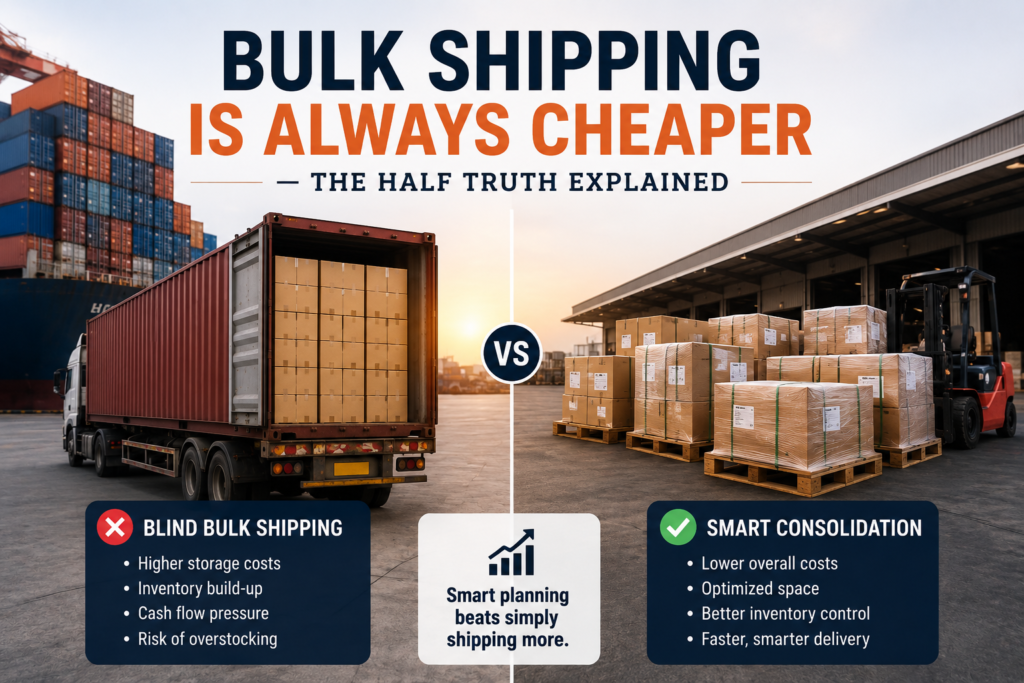
Smart Consolidation vs Blind Bulk Shipping
Here’s where businesses usually get it wrong.
Blind Bulk Shipping
This approach focuses only on volume.
Businesses rush to ship large quantities at once without considering:
- Delivery timelines
- Warehouse readiness
- Inventory movement
- Storage capacity
- Market demand
The result can be unnecessary costs and operational inefficiencies.
Smart Consolidation
Smart consolidation focuses on efficiency instead of just size.
Shipments are grouped based on:
- Destination
- Delivery schedules
- Cargo compatibility
- Cost optimization
- Space utilization
This helps businesses reduce shipping expenses while maintaining smoother inventory flow and better operational control.
In many cases, properly consolidated shipments outperform oversized bulk shipments financially.
Hidden Costs Businesses Often Ignore
The transportation fee is not the only cost involved in shipping.
Businesses that focus only on “cheaper freight rates” often overlook additional expenses such as:
Storage and Warehousing Fees
Excess inventory sitting too long in warehouses can increase operational costs significantly.
Inventory Holding Costs
Large shipments tie up capital in stock that may not move immediately.
Cargo Damage Risks
Improperly packed or overloaded shipments can increase the risk of damaged goods during transportation.
Delayed Distribution
Handling oversized shipments may slow down sorting, delivery, and inventory management processes.
Sometimes smaller, better-organized shipments move faster and cost less overall.
How MGL Logistics Helps Businesses Ship Smarter
At MGL Logistics, shipping is not just about moving larger volumes. The focus is on helping businesses optimize costs through smarter logistics planning.
Strategic Shipment Consolidation
MGL Logistics helps clients combine shipments efficiently to maximize cargo space while reducing unnecessary transportation expenses.
Cost-Efficient Planning
Instead of recommending oversized shipments blindly, the team evaluates:
- Cargo type
- Delivery urgency
- Destination routes
- Warehouse capacity
- Budget considerations
This helps businesses avoid hidden costs while improving shipping efficiency.
Better Inventory Flow
By coordinating shipment schedules carefully, MGL Logistics helps businesses maintain healthier inventory movement instead of overcrowding warehouses with excess stock.
Reliable Logistics Support
From documentation to cargo coordination, MGL Logistics works closely with clients to ensure shipments move as smoothly and efficiently as possible.
Because in logistics, smart planning usually saves more money than simply shipping more cargo.
Final Thoughts
Bulk shipping is not automatically cheaper.
While larger shipments can reduce some transportation costs, true savings come from efficient planning, proper consolidation, and strong logistics coordination.
Businesses that focus only on volume may end up creating unnecessary operational expenses that outweigh the initial savings.
The smarter approach is balancing shipment size with strategy.
At MGL Logistics, the goal is to help businesses move cargo efficiently, reduce avoidable costs, and build logistics solutions that actually support long-term growth.
Because in modern logistics, smarter shipping will always outperform blind shipping.