
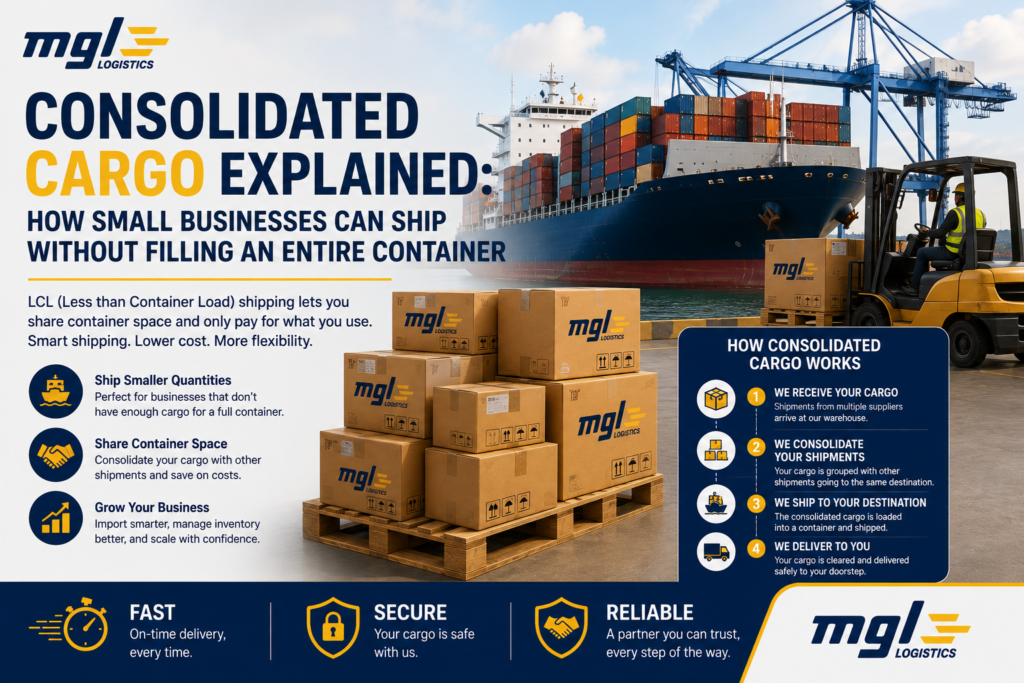
How LCL and cargo consolidation can help small businesses import products without paying for an entire shipping container.
For a small business, importing products internationally can feel like a difficult balancing act.
You want enough inventory to keep your customers happy, but you may not have enough goods to fill an entire shipping container. So what happens when your supplier has finished your order and you’re ready to ship?
Do you have to pay for a full container even when you’re only using a small portion of the space?
Not necessarily.
This is where consolidated cargo, also known as Less than Container Load (LCL) shipping, can be a useful option.
Instead of renting an entire container for your shipment, your cargo can share container space with goods belonging to other customers. You pay for the portion of the container your shipment occupies rather than paying for an entire container.
For small businesses, this can make international shipping more accessible and practical.
At MGL Logistics, we help businesses understand their shipping options and determine when cargo consolidation may make sense for their needs.
What Is Consolidated Cargo?
Consolidated cargo is a shipping arrangement where shipments from different customers are combined into one container.
Think of it like sharing a moving truck.
If you only have a few boxes to move, hiring an entire truck may not be economical. Instead, you can share the available space with other people and pay for the portion you use.
LCL shipping works on a similar principle.
A logistics provider collects cargo from different suppliers or customers, organizes the shipments, and consolidates them into a container. The container then travels to the destination country, where the individual shipments are separated and prepared for delivery.
This allows businesses to access ocean freight without needing enough inventory to fill an entire container.
Why Small Businesses Choose LCL Shipping
For a large importer, filling an entire container may be straightforward.
For a small or growing business, it may take weeks or even months to accumulate enough inventory to make a full container practical.
Waiting that long isn’t always good for business.
You may have customers waiting for products. You may need to restock popular items. Or perhaps you’re testing a new product and don’t want to invest heavily in inventory yet.
LCL gives smaller businesses another option.
You can ship a smaller quantity of goods while still benefiting from the lower transportation costs associated with ocean freight.
You Don’t Need to Fill an Entire Container
This is perhaps the biggest advantage of consolidated cargo.
With Full Container Load (FCL) shipping, a business generally pays for the use of an entire container, whether or not every part of the container is filled with its goods.
With LCL, your cargo shares container space with other shipments.
For example, imagine you have enough inventory to fill only a few pallets or several cartons.
Instead of waiting until you have enough goods for a full container, your shipment can potentially be consolidated with other cargo heading in the same direction.
This can allow your business to import inventory more regularly without committing to a full container.
LCL Can Help With Inventory Management
One of the challenges small businesses face is deciding how much inventory to order.
Ordering too much can tie up valuable capital in products that may take months to sell.
Ordering too little can leave you without enough stock to meet customer demand.
Consolidated shipping gives businesses greater flexibility.
Rather than waiting until you can fill an entire container, you can bring in smaller quantities more frequently and adjust your orders based on actual demand.
This can be particularly useful for businesses that are still testing products or building their customer base.
Consolidation Can Help Businesses Work With Multiple Suppliers
Many businesses don’t buy everything from one supplier.
You may purchase clothing from one supplier, accessories from another, packaging materials from a third, and other products from several different suppliers.
Managing all those shipments separately can become expensive and complicated.
A consolidation service can allow eligible shipments from multiple suppliers to be brought together before international transportation.
For example, a business owner in Ghana may have products ready from four suppliers in the USA.
Rather than immediately shipping each order separately, the cargo can potentially be received, organized, and consolidated before being shipped together.
This creates a more coordinated shipping process and can help the business make better use of available cargo space.
What Types of Businesses Can Benefit From LCL?
LCL can be useful for many small and growing businesses, including:
- Online retailers
- Fashion businesses
- Electronics dealers
- Beauty businesses
- Furniture and home goods businesses
- Auto parts businesses
- General merchandise importers
- Start-ups testing new products
- Small wholesalers
If your shipment is too large for ordinary parcel shipping but not large enough to justify an entire container, LCL may be worth considering.
LCL vs FCL: Which Is Better?
The answer depends largely on the size and nature of your shipment.
FCL can be a better option when you have enough cargo to make an entire container practical. It can also provide greater control over the container and may be more economical as shipment volume increases.
LCL can be more suitable when your shipment is relatively small and you don’t need an entire container.
The goal isn’t to choose LCL simply because you’re a small business. The goal is to choose the shipping method that makes financial and logistical sense for your particular shipment.
At MGL Logistics, we can help you evaluate factors such as cargo volume, weight, destination, shipping schedule, and budget before deciding which option is appropriate.
What Happens to Your Cargo During Consolidation?
A common concern among first-time shippers is whether sharing container space means their goods will simply be mixed together with everyone else’s cargo.
In a properly managed consolidation process, individual shipments are documented and organized so they can be identified throughout the process.
Cargo is received, prepared, consolidated into the container, transported internationally, and then separated at the destination for the appropriate customs and delivery procedures.
This is why choosing an experienced logistics provider is important.
Proper documentation, cargo handling, labeling, and organization all play a role in ensuring that shipments are handled correctly.
Is LCL Always Cheaper?
Not necessarily.
This is an important point for businesses to understand.
LCL can be more economical than paying for an entire container when you have a relatively small shipment. However, the final cost depends on factors such as cargo volume, weight, origin, destination, handling charges, customs requirements, and other applicable fees.
There can also be additional handling involved because LCL shipments need to be consolidated and separated.
For this reason, don’t automatically assume that LCL is the cheapest option simply because you’re shipping a smaller quantity.
The best approach is to compare the available options based on your specific shipment.
When Should You Consider Moving to a Full Container?
As your business grows, your shipping strategy may need to change.
You might start with a few cartons through LCL. Then your sales increase, your supplier orders become larger, and eventually you have enough inventory to make a full container more practical.
At that point, FCL may offer better value.
This is one of the reasons it’s useful to work with a logistics partner that understands your business over time.
Your ideal shipping method today may not be the ideal solution six months from now.
How MGL Logistics Can Help Small Businesses
At MGL Logistics, we understand that not every business has enough inventory to fill a container.
That shouldn’t prevent you from importing.
Our team can help businesses explore suitable shipping options based on their cargo and business requirements.
Depending on your shipment, we can assist with:
- Cargo consolidation
- LCL shipping
- FCL shipping
- Air freight
- Supplier cargo coordination
- Cargo preparation
- Shipping documentation guidance
- Customs support
- Shipment coordination
- Delivery arrangements
Whether you’re importing a few cartons or preparing your first full container, we help you choose a solution that fits your current business needs.
A Practical Example
Imagine you’re a small fashion retailer in Ghana.
You’ve found a supplier in the USA and ordered 15 cartons of clothing. Your supplier has completed the order, but 15 cartons aren’t enough to justify paying for an entire container.
You have two choices.
You could wait until you’ve accumulated considerably more inventory before shipping, which could delay your restocking.
Or you could explore LCL shipping, allowing your cargo to share container space with other shipments.
If the numbers make sense for your particular shipment, consolidation could allow you to bring in the inventory you need without waiting to fill an entire container.
As your business grows, you can gradually increase your shipment volume and eventually determine whether FCL makes more sense.
The Bottom Line for Small Businesses
You don’t need to be a large importer to take advantage of international ocean shipping.
Consolidated cargo gives small and growing businesses access to shipping options that might otherwise seem designed only for companies moving large volumes of inventory.
LCL can provide flexibility when your shipment isn’t large enough for a full container, while allowing you to plan inventory around your actual business needs.
However, every shipment is different. The right choice depends on the volume, weight, value, destination, timing, and overall cost of your cargo.
That’s where having an experienced logistics partner can make the process much easier.
Conclusion
For small businesses, international shipping doesn’t have to mean waiting until you can fill an entire container.
LCL and cargo consolidation can provide a practical way to ship smaller quantities while sharing container space with other customers.
Whether you’re importing products from the USA, building your inventory gradually, or testing new products in your market, consolidation can give your business greater flexibility.
At MGL Logistics, we help businesses understand their shipping options and find solutions that match their cargo, budget, and growth stage.
Your business may not be ready for a full container today—and that’s okay.
Start with what you need. Ship smarter. Grow from there.
MGL Logistics — Fast. Secure. Reliable.