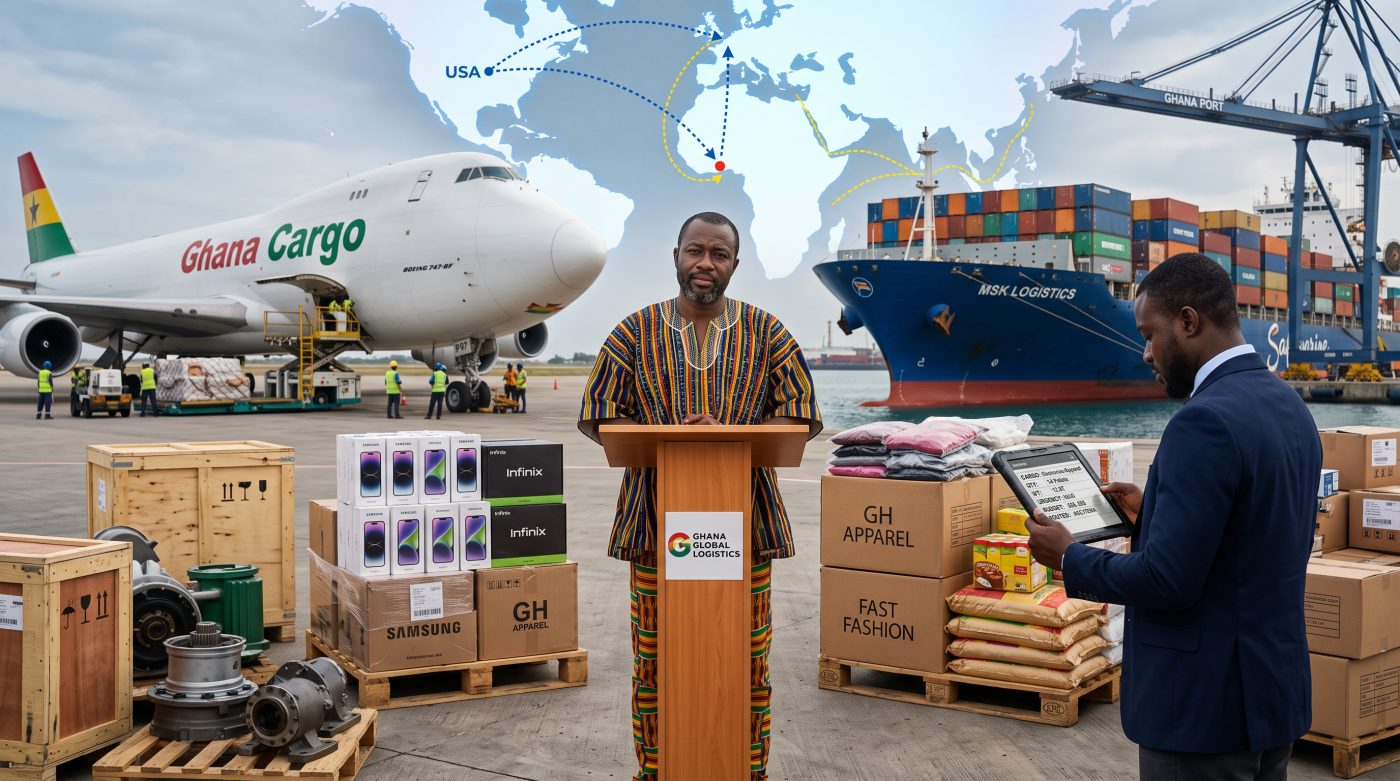
 MGL Logistics team

If you’ve never shipped cargo internationally before, the process can look complicated.
You buy your products in the USA. Then someone mentions a warehouse. Another person starts talking about freight. Then there are documents, customs, ports, delivery…
And suddenly you’re wondering:
“Wait. Where exactly is my package right now?”
Don’t worry. International shipping doesn’t have to be confusing.
Whether you’re a business owner importing inventory, an online seller bringing in products, a retailer restocking your shop, or an individual sending personal belongings to Ghana, understanding the shipping process makes everything much easier.
In this guide, we’ll walk you through how USA-to-Ghana shipping works from start to finish, including pickup, warehouse processing, freight, customs clearance, and final delivery.
At MGL Logistics, our goal is simple: make shipping between the USA and Ghana straightforward, transparent, and reliable.
Let’s start at the beginning.
Step 1: Purchase or Prepare Your Cargo in the USA
Every shipment starts with the cargo.
You may be:
- Buying products from a USA supplier
- Purchasing items from an online store
- Shipping personal belongings
- Sending business inventory
- Buying a vehicle or auto parts
- Consolidating products from multiple suppliers
Before anything moves, you need to know exactly what you’re shipping.
This is important because the type, size, weight, and quantity of your cargo can affect the best shipping method and overall cost.
For example, a few smartphones don’t need the same shipping strategy as several pallets of clothing.
That would be like using a moving truck to deliver one birthday gift.
Possible?
Yes.
Necessary?
Probably not.
Step 2: Arrange Delivery to the USA Warehouse
Once your goods are purchased, they can be sent to the designated MGL warehouse in the USA, depending on the shipping arrangement.
Your supplier can deliver the cargo to the warehouse, or pickup arrangements may be available depending on your location and service.
This is an important stage because the warehouse becomes the central point where your shipment can be received and prepared for international transportation.
Instead of having different suppliers, packages, and shipments scattered everywhere, your cargo can be brought together and organized before departure.
Step 3: Cargo Reception at the Warehouse
When your shipment arrives at the warehouse, the logistics process really gets moving.
The cargo is received and checked against the available shipment information.
The team may verify details such as:
- Number of packages
- Shipment identification
- Sender information
- Receiver information
- Package condition
- General cargo details
This helps identify potential issues early.
Finding a problem while your cargo is still in the USA is considerably easier than discovering it after the shipment has already crossed the Atlantic.
Step 4: Inspection and Shipment Preparation
After receiving your cargo, it needs to be properly prepared for international transportation.
Depending on the shipment, this can involve:
- Checking packaging
- Confirming labels
- Organizing packages
- Reviewing shipment information
- Preparing cargo for consolidation
- Identifying special handling requirements
Proper preparation matters because international cargo can pass through several stages before it reaches the final customer.
Good logistics begins with good preparation.
Step 5: Cargo Consolidation, Where Appropriate
Not every customer needs an entire container.
If you’re shipping a relatively small amount of cargo, consolidation may be a more practical option.
Cargo consolidation involves combining suitable shipments heading toward the same destination into a larger shipment.
This can help customers make better use of available shipping space and potentially reduce transportation costs.
For example, an online seller shipping several boxes of products may not need to pay for an entire container.
Instead, their cargo can travel as part of a consolidated shipment when the service and cargo requirements allow.
It’s basically the logistics version of carpooling.
Why pay for the whole ride when you’re already going in the same direction?
Step 6: Choose Between Air Freight and Ocean Freight
This is one of the biggest decisions you’ll make.
Should your cargo go by air or by ocean?
The answer depends on your business, cargo, budget, and timeline.
Air Freight
Air freight is generally suitable for shipments where speed is a major priority.
It can be useful for:
- Small shipments
- Electronics
- High-value products
- Urgent business inventory
- Time-sensitive goods
The major advantage is speed.
The trade-off is that air freight generally costs more than ocean freight, particularly as shipment size and weight increase.
If your business needs products quickly, however, that additional cost may make sense.
Ocean Freight
Ocean freight is often the preferred option for larger or heavier shipments where cost efficiency matters.
It can be suitable for:
- Business inventory
- Furniture
- Household goods
- Machinery
- Large quantities of products
- Bulk cargo
Ocean freight generally takes longer than air freight, but it can provide better value for larger shipments.
If your inventory isn’t urgently needed, there may be little reason to pay a premium simply to make your cargo travel faster.
Your products aren’t late.
They’re just taking the scenic route.
Step 7: Documentation and Export Processing
Now we get to the part nobody puts on a motivational poster:
Paperwork.
Documentation is one of the most important parts of international shipping.
Depending on the nature of your shipment, relevant documents and information may include:
- Commercial invoices
- Packing information
- Shipping documents
- Cargo descriptions
- Sender and receiver details
- Other documents required for the specific shipment
The exact requirements can vary depending on the cargo and applicable regulations.
Incorrect or incomplete documentation can cause delays, additional processing, or other complications.
That’s why documentation should be prepared carefully before your cargo departs.
Paperwork may be boring.
But customs officials have never accepted “I forgot” as a particularly exciting explanation.
Step 8: Your Cargo Leaves the USA
Once your shipment has been processed and scheduled, it begins its international journey.
Depending on your selected service, the cargo travels by:
Air freight
or
Ocean freight
At this point, shipment tracking and communication become particularly important.
Customers want to know:
- Has my cargo departed?
- Where is it now?
- When is it expected to arrive?
- What happens next?
A reliable logistics provider should keep customers informed throughout the journey.
Step 9: Arrival in Ghana
After the international transportation stage, your cargo arrives in Ghana.
But arrival at the destination does not necessarily mean the shipment is immediately ready for delivery.
There is still an important stage to complete:
Customs clearance.
Step 10: Customs Clearance in Ghana
Imported goods generally need to go through the applicable customs and regulatory processes before they can be released.
Customs procedures can involve reviewing:
- Shipment documentation
- Cargo descriptions
- Declared values
- Applicable duties and taxes
- Other regulatory requirements
The exact requirements depend on the type of goods being imported.
This is one reason accurate documentation is so important.
A shipment that arrives with incomplete or inconsistent information can face additional delays.

Step 11: Cargo Release
Once the relevant customs and clearance procedures have been completed, the cargo can proceed toward the next stage.
Depending on the service you’ve selected, this may involve:
- Customer pickup
- Local transportation
- Door-to-door delivery
- Delivery to a business location
The specific process depends on the shipment and agreed service.
Step 12: Final Delivery in Ghana
Finally, your cargo reaches its destination.
That could be:
- Your home
- Your shop
- Your office
- Your warehouse
- Another agreed delivery location
This is the moment the weeks of planning finally become something you can actually touch.
And yes, this is usually when people suddenly remember they were supposed to tell someone else that the shipment had arrived.
How Long Does USA-to-Ghana Shipping Take?
There isn’t one universal delivery time for every shipment.
Transit time depends on several factors, including:
- Air or ocean freight
- Origin location in the USA
- Destination in Ghana
- Vessel or flight schedules
- Cargo type
- Documentation
- Customs processing
- Port or airport conditions
- Final delivery arrangements
Air freight is generally much faster than ocean freight, while ocean freight is often more cost-effective for larger shipments.
The best way to determine a realistic timeline is to provide your logistics provider with your cargo details and destination.
Don’t plan your business around a guess.
Plan it around a properly assessed shipment.
What Can You Ship from the USA to Ghana?
The type of cargo you can ship depends on applicable regulations and the specific shipping service.
Common categories include:
Electronics
- Smartphones
- Laptops
- Tablets
- Accessories
- Other electronics
Business Inventory
- Clothing
- Shoes
- Retail products
- Office supplies
- Commercial goods
Vehicles and Auto-Related Cargo
- Cars
- Auto parts
- Vehicle accessories
Personal Effects
- Clothing
- Furniture
- Household goods
- Personal belongings
Souvenirs and Gifts
- Gifts
- Collectibles
- Personal items
- Selected souvenirs
Food Items
Certain packaged food products may be shipped where permitted and subject to applicable import and shipping requirements.
Before sending food, electronics, vehicles, or other regulated or restricted goods, always confirm the requirements applicable to your specific shipment.
What Can Cause Delays?
Even a well-planned shipment can experience delays.
Some common factors include:
Incomplete Documentation
Missing or inaccurate information can slow down processing.
Poor Packaging
Damaged or improperly packaged cargo may require additional handling.
Customs Processing
Customs clearance can take additional time depending on the shipment and applicable requirements.
Port or Airport Congestion
Busy periods can affect cargo processing and transportation schedules.
Shipping Schedule Changes
Flight and vessel schedules can change due to operational or external circumstances.
The important thing is to distinguish between unavoidable delays and avoidable mistakes.
You can’t control everything.
But proper planning can help prevent many problems before they happen.
How to Make USA-to-Ghana Shipping Easier
If you want a smoother shipping experience, start with these simple principles.
1. Plan Early
Don’t wait until your inventory is finished before thinking about shipping.
2. Package Properly
Strong packaging reduces the risk of damage during handling and transportation.
3. Prepare Accurate Documentation
Make sure your shipment information is complete and consistent.
4. Choose the Right Freight Method
Don’t automatically choose air because it’s fast or ocean because it’s cheaper.
Choose based on your cargo and business needs.
5. Understand Your Total Shipping Cost
Look beyond the supplier’s price.
Consider freight, handling, applicable import costs, delivery, and other relevant expenses when calculating your landed cost.
6. Work With a Reliable Logistics Partner
A good logistics company should help you understand the process instead of leaving you guessing at every stage.
How MGL Logistics Simplifies USA-to-Ghana Shipping
At MGL Logistics, we understand that international shipping can feel complicated when you don’t know what happens behind the scenes.
That’s why our USA → Ghana service is designed around clear coordination from the beginning.
We support customers with:
- USA warehouse receiving
- Cargo preparation
- Air freight
- Ocean freight
- Cargo consolidation
- Vehicle and cargo shipping
- Shipment tracking
- Documentation guidance
- Customs coordination
- Delivery support
Whether you’re an individual sending personal belongings or a business importing inventory, our goal is to make the process more organized, transparent, and reliable.
You shouldn’t have to become a shipping expert just because you’re importing products.
That’s our job.
USA-to-Ghana Shipping: The Process at a Glance
Here’s the entire journey in simple terms:
1. Purchase or prepare your cargo
2. Deliver cargo to the USA warehouse
3. Cargo is received and checked
4. Shipment is prepared and consolidated where appropriate
5. Documentation is reviewed
6. Air or ocean freight is arranged
7. Cargo leaves the USA
8. Shipment arrives in Ghana
9. Customs clearance is completed
10. Cargo is released
11. Final delivery or customer pickup
That’s international shipping from start to finish.
Not quite as mysterious as it first appeared, right?
Final Thoughts
Shipping cargo from the USA to Ghana involves much more than putting a box on a plane or inside a container.
It’s a process involving warehousing, documentation, freight planning, transportation, tracking, customs clearance, and final delivery.
The more you understand that process, the easier it becomes to plan your shipment, estimate costs, avoid common mistakes, and make better business decisions.
At MGL Logistics, we’re here to simplify that journey.
From the moment your cargo arrives at our USA warehouse to the moment it reaches its destination in Ghana, we aim to provide the coordination, communication, and logistics support you need.
Because international shipping may cross thousands of miles.
But your understanding of the process shouldn’t have to travel that far.
If you’re planning to ship from the USA to Ghana, talk to MGL Logistics about your cargo, timeline, and shipping needs—and let’s find the right way to move it.